RajasthanvTourism

Saturday, 2 May 2020


AMAR SAGAR LAKE

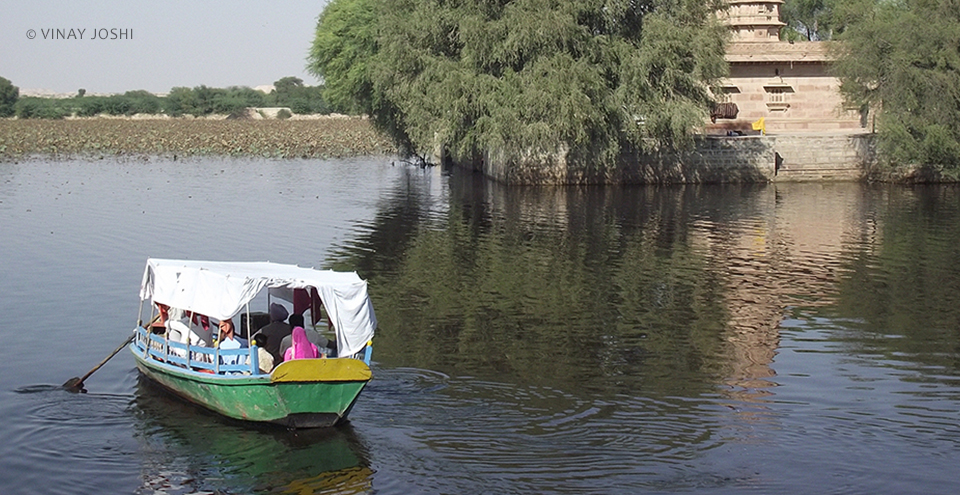
Amar Sagar Lake, located about 7 km towards the western outskirts of Jaisalmer, is a lake cum oasis lying adjacent to the Amar Singh Palace. The palace itself was built in the 17 th century. The complex that includes the palace and the lake is also home to several ponds and wells, along with an old temple dedicated to Lord Shiva. Numerous figureheads of animals carved in stone surround the lake, and according to legends, these carved figureheads are supposed to be protectors of the royal family. At one end, there are pavilions with stairs that lead down to the lake; while at the other end is a beautiful, aesthetically carved Jain temple. A peaceful and tranquil place, the Amar Sagar Lake is yet another spot in Jaisalmer where you have an opportunity to watch a gorgeous sunset.

VYAS CHHATRI

Located in Bada Bagh in Jaisalmer, Vyas Chhatri is one of the most beautiful examples of Rajasthani architecture. This old Brahmin cemetery, full of local versions of cenotaphs, is dedicated to Ved Vyaas, the sage who wrote the epic, Mahabharata. Filled with cenotaphs all throughout, this place is more popularly referred to as the sunset point of Jaisalmer.

 Every evening, hordes of people visit the Vyas Chhatri to get a glimpse of the beautiful desert sunset. Everywhere around here you can see beautiful golden sandstone chhatris that are covered in intricate and delicate carvings. A popular destination among tourists, Vyas Chhatri offers a bird’s eye view of Jaisalmer, the fort, and even the adjoining areas. Visitors can also witness a number of locals at Vyas Chhatri, playing Rajasthani tunes on the algoza, a double fluted instrument, making it an experience that astounds the senses.


JAISALMER WAR MUSEUM

“If you ate today, thank a farmer, and if you ate in peace, thank a soldier!” Our military and defense forces spend their days facing perils and hardships, so the citizens of India can sleep peacefully. While we all appreciate and hold respect for all they do for us, the Indian Army has commemorated the sacrifices of their soldiers in a beautiful display at this war museum, situated at the Jaisalmer military base. This exhibit is primarily to pay respect to all the soldiers who took part and lost their lives in the 1965 India-Pakistan war and the 1971 Longewala battle. A visit to this museum lets you see a number of captured tanks and other memorabilia from the battle, instilling a sense of immense pride in your country and its soldiers. The museum also features an audio-visual room where they screen movies about the battle. You can also see an interview with Major Kuldip Singh Chandpuri who was a crucial part of the Longewala battle. In the video, he gives a detailed description of how the soldiers fought the Longewala battle. The museum also has a war memorial replete with many war trophies and vintage equipment, along with tanks, guns, and military vehicles, murals of soldiers who lost their lives in the war, and weapons which were used during the same. Even the Air Force has given a Hunter aircraft, which was used during the Battle of Longewala in the 1971 Indo-Pak War, as a present to the museum. Located on the Jaisalmer-Jodhpur Highway, the museum has free entry, and holds a very important part of our country’s history. It is truly one of the places that you cannot afford to miss.

RAMDEVRA TEMPLE      Located 12 kilometres from Pokhran on the Jodhpur – Jaisalmer route lies Ramdevra Temple. While most people assume it is a temple dedicated Lord Ram, it is in fact, dedicated to renowned saint Baba Ramdevji. 

The temple marks the eternal resting place of Baba Ramdevji and is visited by people of all faiths. Between August and September, a large fair known as Ramdevra Fair is held here, and it attracts large numbers of devotees who sing devotional songs all night long.

TANOT MATA TEMPLE

Some 120 kilometres away from Jaisalmer is the Tanot Mata Temple. Tanot Mata is considered to be a reincarnation of Goddess Hinglaj. There are many stories of how during the 1965 India-Pakistan war, Tanot was under heavy attack and shelling. However, none of the shells or bombs fired at the temple exploded. This reaffirmed people’s faith that Goddess the temple.
 Post the war, the Border Security Force (BSF) rebuilt the temple and today, the temple is managed by a BSF Trust.

KULDHARA

The underlying history of Kuldhara has piqued the curiosity of one visitor too many, and makes it one of the most enigmatic destinations to visit in Jaisalmer, Rajasthan. The story has a beautiful daughter, an unscrupulous minister, scared villagers, an exodus in the middle of the night, and no idea where the villagers vanished. This is not the story of a movie, but the unfathomable legend that lies behind the abandoned village of Kuldhara. Located about 18 km from the city of Jaisalmer is this old town that was abandoned by its villagers in the 1800s. It was like the entire town vanished in the course of a single night. With about 85 villages full of people, it remains a mystery as to how no one saw them leave; in fact, even to this date, no one knows where all of them went either.

The village remains uninhabited to the day, in the same state that the villagers had left it, hundreds of years ago. The location has become a major tourist destination as people from all over the world travel here to revel in the mysteries of the past. The desolate outline of Kuldhara etches a story in front of your eyes, if you are keen enough to read it!

DESERT NATIONAL PARK

The Desert National Park displays the best of the Thar desert’s ecosystem and its varied wildlife. The Park is formed of undulating sand dunes, jagged rocks, dense salt lake bottoms and inter-medial areas. Various species of animals such as black buck, chinkara and desert fox inhabit the Park. The highly endangered Great Indian Bustard, one of the world's heaviest flying birds, can also be seen here. In winter, the park hosts an incredible variety of migratory raptors such Himalayan and Eurasian Griffon Vultures, Eastern Imperial Eagle, and the Saker Falcon.


  • BADA BAGH

    About 6 kilometres to the north of Jaisalmer lies Bada Bagh, also called Barabagh (literally Big Garden). This garden complex houses chhatris or royal cenotaphs of the Maharajas of Jaisalmer state, including that of Jai Singh II. The location of the garden is such that it offers wonderful sunset vistas to tourists.


GADISAR LAKE

Gadisar Lake was constructed in the 14th century by Maharawal Gadsi Singh to meet the water needs of his arid lands. Considering its importance, many small temples and shrines were constructed around it, transforming it into a pilgrimage centre and a tourist attraction.

JAIN TEMPLES OF JAISALMER

The Jain Temples located inside the Jaisalmer Fort date back to the 12th and 15th centuries. The temples are dedicated to Rikhabdevji and Shambhavdevji, famous Jain hermits known as 'Tirthankars' (wise teachers who taught people how to attain nirvana). Like all other structures in Jaisalmer, the temples are carved out of yellow sandstone. They have been built in the famed Dilwara style which is known for its beautiful architecture.


MANDIR PALACE

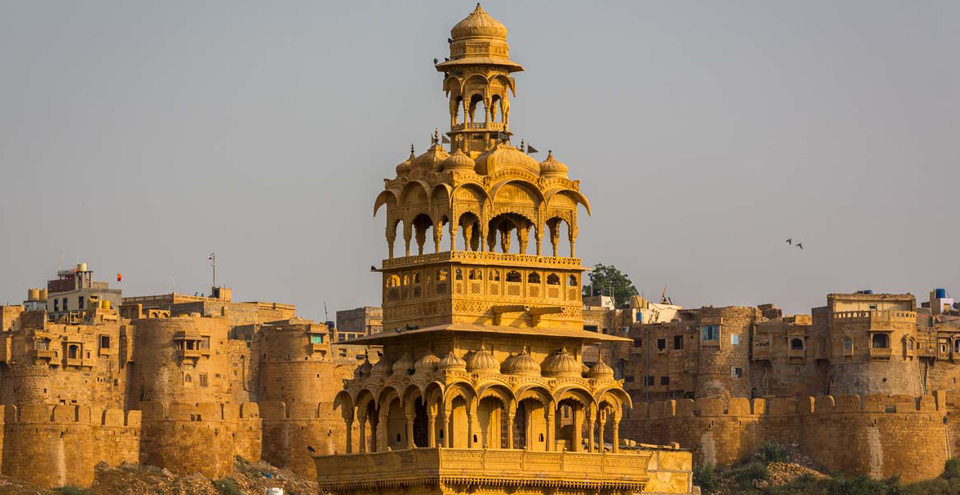
The five-storeyed majesty of the Badal Mahal (Cloud Palace) is further enhanced by its pagoda-like Tazia Tower. Each floor of the palace has an intricately carved balcony. The Badal Palace owes its beauty to the skills of Muslim craftsmen who moulded the tower in the shape of a Tazia (a float that’s part of the procession of Muharram).

PATWON KI HAVELI

Among the largest and the most elaborately carved havelis in Jaisalmer, this five-storey structure sits proudly in a narrow street. While the haveli has lost some of its early glory, a few paintings and mirror work art can still be seen on the inside walls.

SALIM SINGH KI HAVELI

This haveli was built in the first half of the 18th century and a part of it is still occupied by descendants of the original residents. The high arched roof is supported by carved brackets designed in the shape of peacocks. Legend has it that there were two additional wooden storeys that made it match the Maharaja's palace in height, but he ordered for the upper level to be demolished.

NATHMAL JI KI HAVELI

Two architect brothers built Nathmal Ji Ki Haveli in the 19th century. They worked on the haveli from two sides and the outcome is a beautiful blend of the symmetrical construction. Miniature style paintings and mighty tuskers carved out of yellow sandstone are used for decoration.

JAISALMER GOVERNMENT MUSEUM

Established by the Department of Archaeology and Museums, it is a prime attraction for tourists visiting Jaisalmer. The most striking display is the trophy of Rajasthan‘s state bird Godawan (the great Indian bustard). Traditional household items, rock-cut crockery, jewellery and statues from the 7th and 9th century AD displayed here are remnants of the city’s rich cultural heritage.

JAISALMER FORT

The Jaisalmer Fort also goes by the name Sonar Quila (Golden Fort) as it rises from the desert itself and seems to become one with the golden hues of the sand. The setting sun adds its own magic and shrouds the fort with mystique. The fort is constructed in the classic style of the royals by local craftsmen. This fort is a world heritage site and forms an important plot point in one of Satyajit Ray’s famous Feluda stories and corresponding movie, Sonar Kela (The Golden Fortress).

Friday, 24 April 2020


SHIKAR BURJ

Shikar Burj happens to be one of the more well-known tourist destinations located in the city of Bundi. The Shikar Burj is actually an old hunting cottage that was built and owned by the rulers of Bundi, and is located at a little distance from Sukh Mahal. Shikar Burj is nestled amidst the sun dappled forests of Bundi and was the place to which Umed Singh, the ruler of Bundi in the 18th century, withdrew to after he had renounced the throne. Near Sarbagh, Shikar Burj has now been converted into a popular picnic spot and is a great place to spend an evening, relaxing after a day of sightseeing.

CHITRA MAHAL

The Chitra Mahal in Bundi was once a spectacular garden palace that teemed with numerous fountains as well as pools that housed exotic fish. Chitra means painting, and this palace’s name stems from the beautiful murals that adorn its walls. In older times, during the 18 th century, Bundi was a beehive for miniatures, and miniature paintings were highly encouraged. From gods and goddesses, battle scenes, and elephants to images of Radha and Krishna, these paintings depict a special delicacy that is known only in the region. There’s also a Chitrashala in the Chitra Mahal that was made under orders from Umed Singh. Being the innermost chamber of the Mahal, sunlight and moisture hasn’t affected the paintings here, making the art glow with the originality of their painters. In its totality, the walls and ceilings of the Chitra Mahal form a dramatic panaroma that is always worth a visit.

HATHI POLE

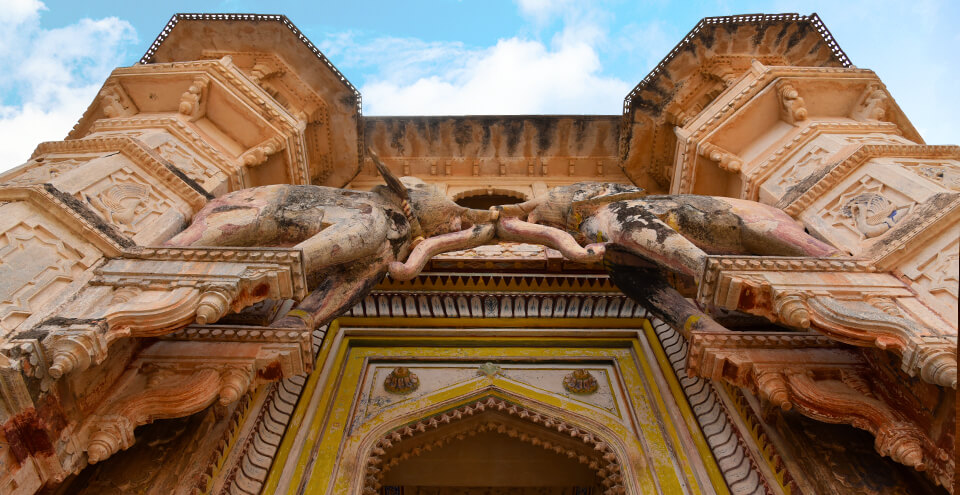
The steep climb to the Garh Palace in Bundi ends at two main gates that are used for entrance. Of these two gates, the most popular is the Hathi Pole. This gate is a huge architectural feat that evokes a sense of grandeur. The gate has two elephants depicting blowing bugles, and was commissioned by Rao Ratan Singh. Marking the entrance of the Garh Palace, the Hathi Pole forms a major point of attraction in Bundi.

Add caption

BADAL MAHAL

The Badal Mahal, also known as the Palace of Clouds, is located within the Garh Palace. The majestic palace’s walls are covered in exquisite paintings which are engaging in their mien, and depict an early influence of the Chinese culture. The royal residence was built in two diverse time periods. In the first stage, the verandah and ground floor was built by Maharawal Gopinath, and the rest of the construction was done in 1609 – 1657 AD by Marahawal Punjraj. Made of Dawra stone, all three arches of the Mahal sport one half-ready lotus, with the longest vault of the Mahal having three half-ready lotuses. When visiting the Mahal, you get entrancing views of the inside and outside of the fortifications, making the palace a must-visit destination in Bundi.


GARH PALACE BUNDI

The Garh Palace in Bundi is counted among the largest palaces in India, even if it is a little less known. Inside, the palace is a collection a number of palaces that were built by different rulers over the span of 3 centuries. Garh Palace is known for its Rajput architecture, which is easily noticeable in the jharokhas and pillars, many of which sport elephant carvings. Some of the famous palaces here include Chhatra Mahal, Phool Mahal and Badal Mahal, but one of the most famous ones has to be the Chitrashala, which has a fascinating pavilion and gallery of miniature murals. The palace is open to visitors from 8.00 am in the morning till 5.00 pm in the evening. There is a small entry fee that has to be paid, and one has the option to hire a guide who can take you through the stories and history of this beautiful palace.

PHOOL SAGAR

A personal property of the descendants of the royal family, this artificial lake gets its name from the palace on its banks. This palace houses an exclusive collection of paintings created by Italian prisoners. Beautiful gardens surround it and the lake. Make sure you obtain special permissions required to explore the palace and its grounds.

RAMGARH VISHDHARI SANCTUARY

Ramgarh Vishdhari Wildlife Sanctuary is located 45 kilometres from Bundi on the Bundi-Nainwa road. Covering an area of 252 sq. km., this sanctuary is home to a variety of flora and fauna. Established in 1982, it forms a buffer for Ranthambore National Park. The best time to visit is between September and May.

LAKE KANAK SAGAR

About 67 kilometres from the town of Bundi lies this wonderful flat lake. There is also a town named after the lake. One can spot several migratory birds here such as bar headed goose and Demoille cranes all through the year.

LAKE NAWAL SAGAR

Nawal Sagar Lake is an artificial lake that is a major tourist attraction and can even be seen from the Taragarh Fort. There is a half-submerged temple dedicated to Lord Varun Dev in its centre. What makes the lake unique is that one can see the reflection of nearby palaces and forts in its waters.

LAKE JAIT SAGAR

Located close to the Taragarh Fort, this picturesque lake is surrounded by hills and covered with pretty lotus flowers that bloom during winter and monsoon.

84 PILLARED CENOTAPH

As the name suggests, the 84 Pillared Cenotaph is a structure supported by 84 columns. Commissioned by Rao Anirudh, the Maharaja of Bundi, this cenotaph is a tribute to his beloved wet nurse, Deva, who he loved dearly. A popular tourist attraction, this impressive structure is decorated with carvings of deer, elephants and apsaras.

TARAGARH FORT

Built in 1345, Taragarh is one of the most impressive structures in Bundi. While it may be a bit ramshackle and strewn with overgrown vegetation, the palace grounds are a great place for a leisurely stroll. With its curved roofs topping pavilions, excess of temple columns and elephant and lotus motifs, the palace is a tribute to Rajput style.

NAGAR SAGAR KUND

Located outside the Chauhan Gate, the Nagar Sagar Kund, a set of twin step wells, was constructed to provide water during times of famine.

DABHAI KUND

Shaped like an inverted pyramid, the Dabhai Kund, also known as Jail Kund, is the largest of its kind in Bundi. The fantastic carvings on the steps that lead to the water alone are reason enough to warrant a visit.

RANIJI KI BAORI

Raniji ki Baori, also known as 'Queen's Stepwell', is a famous stepwell built in 1699 by Rani Nathavati Ji, the younger queen of the ruling king Rao Raja Anirudh Singh of Bundi. This multi-storied stepwell displays excellent carvings of Gajraj with his trunk turned inwards, giving the impression of having drunk from the baori on its pillars. Its high arched gate gives it an inviting appearance.

KSHAR BAG

Located near the Chhatra Vilas Garden, Kshar Bag, sometimes known as Saar Bagh, houses the memorial cenotaphs of the royal family of the Bundi state. It is located on the Shikar Burgh Jait Sagar Road.

SUKH MAHAL

Sukh Mahal, a small, two-storied palace was a summer retreat of past rulers. Today, it is quite famous for being the place where Kipling wrote ‘Kim’. Many credit the palace as a having played muse to the renowned novel. In fact, part of a movie based on the novel was even shot here.

HORSE ECOTOURISM

The National Research Centre on equines, Bikaner Campus has recently taken an initiative to conserve and propagate equines through ecotourism. The Campus has now been opened for the Indian and Foreign tourists. The ambience of thecampus in itself is a big attraction. However, the campus has initiated Horse Riding, Pony Riding, Tonga Riding and Buggy Riding in the lush green zones of the campus to give nature-talking environment on one hand and a Desert Point with a traditional hut for the fragrance of the state, the Rajasthan, on the other hand. The elite Marwari horses, the Pride of Rajasthan; Kathiawari horses, the Elegance of Gujarat; Zanskari horses, the Ponies of Ladakh and Manipuri horses, the Famous Polo Ponies along with the French Poitou donkey and White Gujarati donkeys constitutes other major attractions. An Equine Information Centre has been developed for the depicting the basic technical details about the horses. The equine harness and implements are also worth seeing. The hydrotherapy pool for the natural treatment of equines is also worth visiting. Another beautiful part of the campus is the Souvenir shops offering the handicraft items, leather items and traditional Rajasthani dried vegetables for sale.

JORBEED

Bikaner in Rajasthan is one of the best places for birders if they want to spot some vultures. But, drive for about 12 km from the city, and you reach Jorbeed. If you are a birder, then Jorbeed is your ‘spot of opportunities’. Jorbeed is one of the best placesto look at raptors. Birds like the Steppe Eagles, Griffon Vultures, and Egyptian Vultures are as common as crows in this region. A place you’ll certainly have to come to terms with, you will hardly see a single tree here without some or the other raptor resting on it.A visit to Jorbeed is all about seeing the largest congregation of eagles and vultures in Asia, and if you are lucky, you might even spot the rare yellow-eyed pigeon here as well. With thousands of magnificent raptors dotting the landscape, Jorbeed is truly a birder’s paradise.

KATARIASAR VILLAGE

45 kilometres from Bikaner on the Jaipur Road is a village rich in ethnic, rural and cultural life. In Katariasar, one can walk on sand dunes and view the sunset against the desert landscape. The main attraction of this village is its inhabitants, the Jasnathjis, who are fire dancers. Herds of chinkaras, desert foxes, rabbits, peacocks, parrots and partridges can be spotted here.

KOLAYAT

Kolayat is an important pilgrimage place for Hindus. Locals as well as devotees from distant places visit this temple complex every year. History tells the story of Kapil Muni, the advocate of Shankya yoga, who was so mesmerised by the serenity of this place that he interrupted his journey to the northwest and stopped here to carry out a ‘tapasya’ (penance) for the redemption of the world. The main attractions of the town are its several temples, ghats, the sacred lake and the town market. Kolayat is about 50 kilometres from Bikaner.

RAJASTHAN STATE ARCHIVES

Visitors to the archives are mostly researchers and academicians who come here to study the ancient administrative records that are preserved here. Some of the records date back to the Mughal period and include, among others, Persian Farmans, Nishans, Manshurs, etc. Records created during the administration of the various princely states of Rajasthan can also be found here. This exceptional collection is of immense value.

DEVI KUND

8 kilometres from Bikaner is the royal crematorium. It has several exquisite chhatris (cenotaphs), each dedicated to the memory of a ruler of the Bikaji dynasty and situated on the exact spot where each of them was cremated. The chhatri of Maharaj Surat Singh is a fine example of the architecture of that era. 

Devi Kund also has cenotaphs of 22 female members of the royal family prior to Maharaja Gaj Sigh Ji, who committed sati. There is also one cenotaph of a Sata (male sati) of a ruler. Maharaja Surat Singh's Chhatri is built entirely in white marble with spectacular Rajput paintings on its ceiling.


GAJNER WILDLIFE SANCTUARY

Barely 32 kilometres from Bikaner, on the Jaisalmer road, is a lush green forest which is a haven to the nilgai, chinkara, black buck, wild boar, flocks of imperial sand grouse and many other species of migratory birds that make the sprawling forest their winter home.

GAJNER PALACE AND LAKE


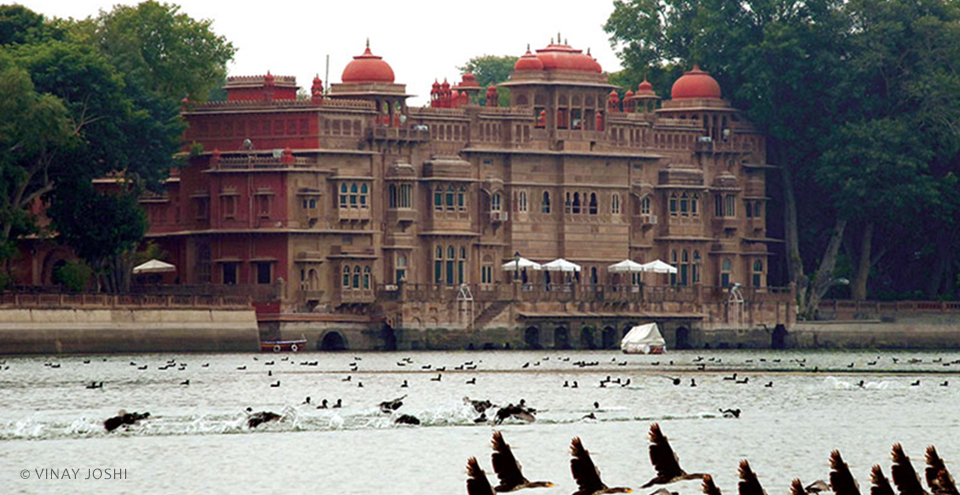
Gajner is an incomparable jewel of the Thar. The Gajner Palace was founded by Maharaja Gaj Singh ji of Bikaner in the year 1784, and then completed by the great Maharaja Ganga Singh of Bikaner on the banks of the lake. It was meant to serve as a hunting and relaxing lodge for the royal family as well as for visiting guests. It has now been converted into a hotel

SHIV BARI TEMPLE

Located just 6 kilometres from Bikaner, this Shiva temple is fortified by a high wall. It was commissioned and built by Maharaja Doongar Singh in the 19th century to commemorate his father Maharaja Lal Singh. The highlights of this red stone temple are beautiful wall paintings, the four-faced black marble Shiva statue and a bronze Nandi statue facing the Shiva-Lingam. The temple also houses two large reservoirs of water known as bawaris.


SHRI LAXMINATH TEMPLE

The rulers of Bikaner regarded Lord Laxminathji (Lord Vishnu) as the real king of Bikaner and themselves as his Deewans or Ministers. This temple, made of marble and red stone, was constructed to enshrine Lord Laxminath whose throne rests here.


KODAMDESAR TEMPLE

24 kilometres from Bikaner is the Kodamdesar Temple. Kodamdesar Bhainru Ji was installed by Rao Bikaji sometime during the first three years of his arrival from Jodhpur. This place of worship was initially chosen as the site to lay the foundation of Bikaner, but was later shifted to its present location.


JAIN TEMPLE BHANDASAR

ain Temple Bhandasar is a 15th century temple dedicated to the 5th Tirthankar (a person that has conquered the cycle of life, death and rebirth and paved the path for others to attain nirvana), Sumatinathji, and is one of the oldest monuments of Bikaner. The temple design includes intricate mirror work, murals and gold leaf paintings. Devotees throng to the temple from all corners of the country.


DESHNOK KARNI MATA TEMPLE

The Karni Mata Temple at Deshnok is a beautiful structure made of stone and marble, inside which resides an image of Karni Mata. The image is decorated with a ‘mukut’ (tiara) and garlands. The images of her sisters and the sisters of Avad Mata give her company on either side. The temple is known the world over for the presence of kabas (rats) that roam freely within the temple precincts. 

Thursday, 23 April 2020


PRACHINA        in the great Junagarh Fort, this museum hosts royal costumes, textiles and accessories of Rajasthani royalty. The 'Poshaks' (garments worn by ladies) are a reminder of the now lost craft of traditional designs, styles and workmanship.

 The family portraits on display narrate a story about how changing cultural settings influenced the style of immortalising the former rulers.


LAXMI NIWAS PALACE

                        Laxmi Niwas Palace was the residence of the king of Bikaner, Maharaja Ganga Singh. Built between 1898 and 1902 by British architect Sir Samuel Swinton Jacob, this structure displays an Indo-Saracenic
architectural style. It is now a luxury hotel.

GANGA GOVERNMENT MUSEUM

Described as the best museum in the State, the museum contains a rich display of archaeological artefacts from Harappa and the early Gupta periods. There are separate sections for paintings, arts and craft, woven carpets, clay pottery, ancient coins and Rajput weaponry.

RAMPURIA HAVELI

Bikaner has several havelis (aristocratic homes), the most famous cluster being the Rampuria Group of Havelis. Built of dulmera (red) stone, every aspect of the havelis – jharokhas (casements), entrances, latticed windows, divankhanas, gumaharias or basements – is simply exotic. Leaves and flowers decorate every jharokha, lending it a pleasant touch. These massive havelis are decorated with golden work of the highest quality. Their dankhanas (drawing room) take one back to the Mughal and Rajput era. One can notice an abundance of Victorian influence in their design as well. The wood carvings in Rampuria Havelies are extremely exquisite. Spaced close to each other, the havelis are truly a sight to behold.